|

The first thing to do as with buying any thing from
a television to a house, is research information for the model
you have chosen to purchase. Prices can vary wildly, from private
to different shops, from good machines to bad, from customised
to original, and whilst you should buy with caution a machine
to cheap to be true, you also do not want to pay over the odds
for your desired scooter. Having said that one or two models covered
further down pretty much command their own price tag, the amount
of machines available for sale compared to demand allows sellers
to demand the best price possible.
We are sent e-mails several times a week asking should I buy from here or there well I am going to be brutal here the answer is NO.
Lets be honest if you have never heard of a company before would you give them your hard earned money knowing nothing about them? There are more and more restoration experts, scooter shops, dealers opening up every week, UK, Far East, India, it seems every corner of the globe. Whilst I am not saying a new bussiness is not law abiding, capable of producing top quality work, you really do need recomendations, or at least to see the work or scooter before you buy.
It really is worrying that more and more people seem to want to buy that bargain as it has shiney paint, well that paint might look good but it will be just as heavy as tatty scooter when you have to push it every where! If you want help, or to ask about this scooter, that dealer, I would suggest the place place to do this would be in the forums as here you will get independant advice from fellow Lambretta riders.
All of the above probably sounds very negative, it is meant to be, the last thing we want is for you to buy a nasty Lambretta and spoil your enjoyment and view on the world of owning a Lambretta. Do not let this put you off buying one from what ever source though, we have stated this to hopefully make you sit up and think and not rush into a deal. There are good scooters out there, where ever in the world you choose to buy one, but take your time and get the right one!
At present correct frame to
engine numbers appears to be the most important thing for buyers,
Italian Lambretta frame and engine numbers never matched, some
of the time they could be up to several thousand numbers apart.
Spanish built Lambrettas on the other hand always matched, but
for some reason these machines fail to demand as much money as
their Italian counter parts, but because of this can often be
brought at more sensible prices.
So what to look for, well further down you can find
specific hints and tips for each model, but as a general overview
for Lambretta machines, you should consider the following points.
| Below in the left hand column is what
to look for, on the right hand column is a scooter purchased
through the adverts from Scootering magazine and its what you
are trying to avoid! |
This scooter was in a copy of Scootering
magazine for sale at £1450.00, offered as an Italian import
with LCGB certificate! Of course it is not an import from
Italy, but from the Far East, we can tell this because of
certain trims, badges and general bodges always seen from
bad restorers in this part of the world (were not saying they are all the same, there are good shops
also, as there is good and part in all parts of the world). While this particular scooter is genuine, it is a good example to use due to some bad bodges on the machine to try to show what to avoid.
|
1) Check frame and engine numbers against
the log book. While many Lambrettas could have had an engine
change due to improving the performance, or broken casings
etc, the correct details for buying an original machine are
important. If speed or originality are not important to you
then this is not such a great problem, but certainly at least
the frame number must match the log book. Check the area of
the frame number itself, as certain Lambretta machines become
rarer, unscrupulous characters out there have been known to
"ring" the top models. Ringing is giving a false identity
to machine. i.e. taking a Spanish built Serveta and turning
it into an Italian numbered machine means you have not brought
what you thought you had, the scooter is also illegal and could be confiscated
and even crushed if found to be incorrect.
|
 1)
Although it is not clear in this picture, look closely at the
frame number. We are looking for a nice even stamping of numbers, no signs of tampering or differing heights in numbers, heights, etc etc.. 1)
Although it is not clear in this picture, look closely at the
frame number. We are looking for a nice even stamping of numbers, no signs of tampering or differing heights in numbers, heights, etc etc..
 All Innocenti Lambretta (except one) carry an IGM number, also make usre there is one present, and try to find out what that should be as each model range had its own number. The IGM is the type approval number, which every thing made in Italy must have. All Innocenti Lambretta (except one) carry an IGM number, also make usre there is one present, and try to find out what that should be as each model range had its own number. The IGM is the type approval number, which every thing made in Italy must have.
|
| 2)Imported machines that we
see so many of do not tend to suffer from rot and rust, what
damage you normally find will be visible instantly. Leg shields
and panel work can be quickly inspected for rust holes and
dents. In general Lambrettas stand up to the elements of time
very well, the machine would have had to be very badly stored
for it to be totally rotten and useless. The main frame tube
is very well made, although I have seen some horrors on scooters
imported from third world countries, and of course Italy itself,
in general the main tube is solid apart from where the number
plate is located, this should be checked for rust damage.
It is not unknown for some importers of scooters to stand
the scooters on this number plate part of the frame to cram
more machines into a container. Check panel alignment and
general alignment of the number plate area as this can easily
be damaged by this practice. Leg shields normally rot at the
bottom, where you would put your feet, in particular where
the channels are fitted should be looked at closely as these
can act as a water trap. Follow the Leg shield beading down
to the bottom and the top, again there is an alloy end cap
at each end, try and check under here as this is the most
common place for Leg shield splitting. Rear floorboards will
unless the machine has been restored, will almost certainly
be split. They tend to split right in the middle, as passengers
tend to put their weight on them when getting on the machine.
They are a foot rest, and really will not stand continual
heavy weight. Side panels should be checked inside and out
for signs of dents and damage. Side panels can also spilt,
on the main frame the is a leg that comes down by the petrol
tank, the side panel rests against a rubber that sits on here
to stop it vibrating. Trouble is with years and years of being
pushed out slightly by this rubber the panel is known to split
at this point. Again easily visible and repairable. In bad
cases side panels can rot at the very top and at the lower
edge, but this can be easily viewed unless hidden by many
layers of paint or power coat. On any body work and good easy
check is to take a small magnet with you and run it over the
body work. The magnet will not be attracted to layers of filler,
or holes botched up.
|
| 3) Get underneath the scooter, the main
strut that the stand is fixed to, can quite often break away
from the frame itself. This will cause the scooter to wobble
on its stand, not sit straight on its stand, and at worst
distort the leg shields. Whilst this is easily fixed with either
a new strut, or re fixing the original, it does involve welding.
If the scooter has nice paint work then of course this will
be spoilt by the welding needed to fix this on. If this problem
is on a scooter that is to be restored, then there is no problem
as this can easily be rectified during restoration. Examples
on the left show you what to look out for, don't buy one like
this!
|
 Although
you cannot see for certain in this picture, the main Leg shield
strut has broken and bee re-welded. No problem with this it
is quite common, but if you repair it, it needs to be straight! Although
you cannot see for certain in this picture, the main Leg shield
strut has broken and bee re-welded. No problem with this it
is quite common, but if you repair it, it needs to be straight!
 Again
not really a problem, but bad weld on the front strut is visible. Again
not really a problem, but bad weld on the front strut is visible.
|
| 4) Headset top and bottoms should match
nicely, if during the machines history either the top or bottom
headset has been damaged, or changed for some reason, it can
often be quite hard to match the top and bottom so they fit
nicely. For example many Lambretta GP machines out there may
have had an Indian headset top fitted, also Li Special, SX
and TV machines could have had Spanish tops fitted. You can
notice they do not line up properly but looking at the headlight
rim closely. Headset top and bottoms never rust, but they
can suffer from alloy corrosion if left to the elements. Mainly
this is easily fixed with heat when stripping and alloy part,
but they can also be brittle and break.
|
 We
have not done this picture in a larger version because there
is nothing wrong with it. The reason we show you it is because
it does not have a chrome ring. The letter that came with this
scooter from the LCGB correctly states it as a 1963 by its frame
number. If the buyer had done his homework, he would have known
a 1963 TV175 had a chrome ring under its headset! This could be down to a bodge repair, fitting the wrong parts or ringing. We
have not done this picture in a larger version because there
is nothing wrong with it. The reason we show you it is because
it does not have a chrome ring. The letter that came with this
scooter from the LCGB correctly states it as a 1963 by its frame
number. If the buyer had done his homework, he would have known
a 1963 TV175 had a chrome ring under its headset! This could be down to a bodge repair, fitting the wrong parts or ringing.
|
| 5)Internally the main problem with scooters
that have been stood for years is rust inside the petrol tank.
Take the lid of and run your finger around the top of the
tank. If it feels all gritty you have a rust problem. This
can be cured by treating the rust, quite a few methods are
available, or you could just replace the tank. Tool boxes
are generally fine, owners drilling holes or dents are their
main fault. Plastic tool boxes on the other hand can become
brittle and discoloured with time, check these at their mounting
points more carefully. Air boxes rarely suffer from rot or
damage, the most damage you normally could find on stripping
the scooter is the captive nut at the top that secures the
air box. Rear mudguards can suffer from rust holes and dents,
try to pay attention to the rear of the mudguard in particular.
|
| 6) Wheels and hubs can easily be replaced,
wheel rims are cheap enough not be concerned about. Rear hubs
can be considered a serviceable item as they can wear. The most
important thing to check is that the two wheels are in alignment
with each other. A correctly executed M.O.T will check this.
Normally they place a "straight edge" piece of wood or metal
so it touches both wheels. The straight edge should sit flat
against each wheel from both sides. If one wheel is not flat
against the edge, the most common fault would be worn engine
mounts. Twisted or bent frame should also be checked for if
the wheels do not line up, if in doubt I would seek expert advice.
It is very common with cheap "restorations" to see the front
forks, bolts etc painted without being stripped. Not only does
this look horrible, but also shows that no care has been taken
to check 40 year old suspension, at least it will fail the MOT,
at worst in can lead to poor handling, UN even braking & tyre
wear. Tyres, the side walls and rear suspension should be checked,
these are so cheap now ideally they should be new, or replaced
on an machine brought for restoration. |
 Although
not the best angle to take this picture from, here you can see
that the rear wheel is leaning over to the side by some amount.
This is particular example is quite bad due to the frame and
engine case damage seen elsewhere, but others are not so bad
but still as dangerous. Although
not the best angle to take this picture from, here you can see
that the rear wheel is leaning over to the side by some amount.
This is particular example is quite bad due to the frame and
engine case damage seen elsewhere, but others are not so bad
but still as dangerous. Front
forks are badly corroded, but painted and patched in any case.
If rot is allowed to continue in this area the forks could just
fall apart if you hit a rut in the road. Front hub has been
welded and messed about with to make the TV disc links work
with a drum brake! Front
forks are badly corroded, but painted and patched in any case.
If rot is allowed to continue in this area the forks could just
fall apart if you hit a rut in the road. Front hub has been
welded and messed about with to make the TV disc links work
with a drum brake!
 
Suspension / Tyres |
7) This leaves us the engine, the heart
of any vehicle. The basic design of Lambretta engines from Li
series one to the last GP share the same family of design, and
more often then not are fully interchangeable. Main points of
concern cannot really be checked until the engine is in the
workshop and stripped. Obvious checks can be made to the outside,
but this is mainly for damage and worn threads. Check the engine
side casing, this is held on by many studs and nuts, or in some
cases bolts. The threads on the actually casing itself quite
often can deteriorate due to constant removal / refitting, or
over tightening. Are all the nuts/ bolts tight and in place.
Around the flywheel and cylinder cowl similar problems occur,
this will normally allow the respective cowling to rattle and
vibrate and should be easily detectable. Check the rear hub,
grab the tyre at the three and six O'clock positions and try
to wobble it. Almost all Lambrettas have a very slight amount
of rock, this is quite normal, but excessive rock or clanking
noises at worst could need a complete engine strip to replace
the rear hub bearing. Early models were fitted with MA/MB series
of carbs, many of which leak and suffer from lack of spares.
The later SHE series of Dell'orto carbs are often still serviceable,
spares are fairly readily available, with only weird threads
really the main problem on these carbs once they have been overhauled.
8) Test drive the scooter, if your going to do this
on the open road as I suggest you do, are you actually insured
to ride it? Start the engine, and make sure you go for a test
drive long enough to get every thing warm, not just down the
end of the drive and back, this will get every thing warm and
at correct running temperature. While out on the test drive
check the gears, most selection problems can be down to badly
adjusted cables or worn outer selection bar, easily fixed. Try
the scooter in second and third gear while riding, accelerate
hard, most internal problems will cause the scooter to jump
out of these gears. Normally the selector itself will be at
fault, this part is readily available and cheap enough to replace,
but it also requires most of the engine to be stripped to be
fitted. When the engine is hot, does the scooter idle properly,
check there is no white smoke as this can mean an oil seal is
defective. Again oil seals are very cheap but the not so mechanically
minded would have trouble fitting them. Check suspension and
steering while riding, steering should be straight you will
easily spot incorrect alignment as the headset will point off
centre while you are riding in a straight line. Bounce the scooter,
if the front or rear bounce more then twice it needs repair
or replacing, easily rectified, just a pain to have to do it.
Ask the seller to take the spark plug out, check the colour
is a chocolate brown colour, a good indication that all is well.
Stop the scooter when hot, try to re start it, ill serviced
Lambrettas are often quite hard to re start when hot. Although
this can quite often be easily fixed, there are a whole host
of reasons why they do not re start, time and trouble is more
the problem then a major or expensive fault. |
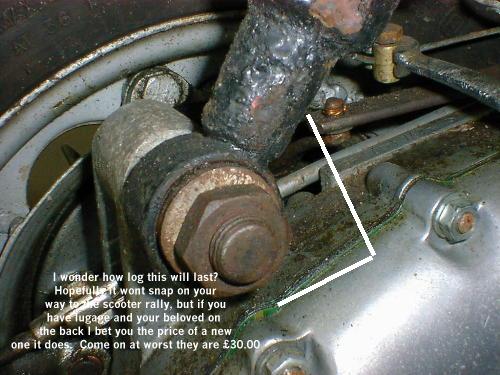
Unfortunately our engine write up could do with
a whole page on its own, our buyers TV175 came with a whole
host of horrors leaving this TV fit for one thing, scrap metal.
Lets start with the casing itself, so badly repaired, you will
have seen on earlier pictures the rear wheel is at a terrible
angle, then we opened up the chain casing to find the following
horrors.
 The
chain was in terrible condition, rollers missing, chain so stretched
it could quite easily fall off and jam the rear wheel totally. The
chain was in terrible condition, rollers missing, chain so stretched
it could quite easily fall off and jam the rear wheel totally.
 Front
sprocket retaining sleeve was home made, this can quite easily
break and cause major damage. Front
sprocket retaining sleeve was home made, this can quite easily
break and cause major damage.
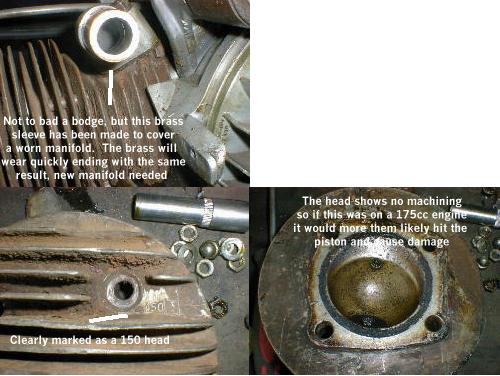
The following group of four photos, show that although this
scooter is supposed to be a 175, it is fitted with a 150 top
end. A couple of cooling fins were broken off, no great problem,
piston although new is of poor quality.

 Next
we have the crank shaft, looking closely we think this is a
standard Li crankshaft. Notice the Innocenti markings on it,
a forty year old crankshaft well beyond serviceable condition. Next
we have the crank shaft, looking closely we think this is a
standard Li crankshaft. Notice the Innocenti markings on it,
a forty year old crankshaft well beyond serviceable condition.
 The
clutch is the heart of most machines, transferring power from
the cylinder to the gearbox, it is quite important. So important
for our buyers scooter who ever did this took the time and trouble
to make on, only not very well is our big problem. The
clutch is the heart of most machines, transferring power from
the cylinder to the gearbox, it is quite important. So important
for our buyers scooter who ever did this took the time and trouble
to make on, only not very well is our big problem.
 As
well as the clutch being useless, the clutch basket, rear sprocket
and complete assembly is beyond belief as to how bad we found
it. No way would this have lasted more then a couple of hundred
miles at the most. As
well as the clutch being useless, the clutch basket, rear sprocket
and complete assembly is beyond belief as to how bad we found
it. No way would this have lasted more then a couple of hundred
miles at the most.
 We'll
let the gearbox pictures show you the horrors in here. Just
click the pic to see more! We'll
let the gearbox pictures show you the horrors in here. Just
click the pic to see more! |
9) Finally modifications, many many
Lambrettas for sale out there have been personalised or modified
by previous owners. Some modifications are well worth it, such
as electronic ignitions, others are more personal such as crash
bars, lights and mirrors. The reason I mention this is if you
buy a scooter with crash bars fitted and you do not like them,
you will be left with two holes in the leg shields when you take
them off. The same can be said with any accessory you intend
to remove if you purchase the Lambretta, check that when you
remove the item no horrors are underneath. Engine modifications
are probably by far the most common upgrade, as the Lambretta
is more then likely over thirty years old, improvements or modifications
to make the Lambretta keep up with modern traffic will have
occurred. Most adverts will display a whole host of modifications
carried out, owners are normally proud to reel of the long list
of modifications. Just remember the more exotic modifications
will be more expensive to put right should they fail. You could
quite easily write a book about all the different modifications,
some are good, some well lets say just ask yourself if this
is the type of modification you want. Is the product fitted
still available for purchase, important for replacing parts
that go wrong. Many modifications while giving you more power,
will also give more wear and tear on the engine components inside.
How long ago was the modification carried out, this is a hard
one as if the modification was good and not carried out that
long ago, why is the seller selling after spending that much
money on such an improvement. If the product is not know to
you or friends, and has been on there for many years, what happens
when it goes wrong, can it be easily fixed? Colours and paint
schemes again are a personal thing, this is purely down to whether
you like it or not. Engraving and chrome on customised scooters
should be treated with caution if you wish to return the scooter
to original spec as it is virtually impossible to remove engraving,
expensive to de chrome items and to return to original condition.
On the other hand if this modification is to your taste, then
this is a bonus as engraving and chroming can be very expensive
to have done properly. |
Specific guide to models
Model M (A) & B
Having been built in the late forties, and few examples built compared
to later models, these two early Lambretta machines are quite hard
and rare to find. You can probably count the amount of experts to
these machines around the world on one hand, and really I would
suggest you research and possibly purchase these models through
these people. When buying these models originality counts for more
then any thing, although most models will have been restored by
now. Parts are mainly re made from one source in Italy, although
these can some times be purchased by agents in different countries,
expect spares to be at least difficult to obtain. Serious Lambretta
collectors now seem to own most of these scooters
C. LC, D, LD, E, F
These models in the UK are not as popular as the later models as
they cannot be tuned for reliable fast use with many machines topping
out at fifty miles an hour, and taking a long time to get there.
3 speed gearbox is the only let down on these scooters, the gap
between second and third is on the large side. Many Lambretta enthusiasts
actually regard them as the last real Lambretta, very well engineered,
mostly open framed apart from the "L" versions and shaft driven.
Many new trims, badges, lights, etc are available, but in general
these early models are a bit harder to get hold of parts for. There
is only a handful of shops / experts that stock a good range of
parts. Technically these models are very good, if cared for and
serviced well, they can expect to cover over 40,000 miles without
a major overhaul. If a major overhaul is required, take care as
some of the engine parts can be both delicate and tricky to fix.
General servicing and maintenance is pretty easy on these models.
Body work in good condition is hard to find these days, so make
sure all is complete and not rotten.
Li Series 1
Early frame breather series 1 have a single oil seal on the stator
side of the crankshaft which is lubricated by the fuel/oil mixture
feed through a small channel. Ideally this needs to be upgrade to
the later style magneto housing to be used as a reliable machine,
some engineering is needed to be able to do this. Check that the
rubbers are in place and useable for the air intake system on frame
breather models as finding replacements is currently very hard.
Single piece criss cross channels on the front floor of the leg shields
can be expensive to replace but are readily available from most
good shops. No new body work is currently made for the S1 apart
from a few odd Indian parts which are different in shape. All badges
and trim, including seat covers etc are easily purchased. Mechanically
virtually all parts can be brought off the shelf.
TV Series 1
The TV 1 is quite a rare machine now due to the low numbers made
in the first place, kick start and gearboxes can be difficult compared
to the more normal arrangement of later models. Genuine seats are
often impossible to find, and command high prices for good examples.
The TV 1 had a seventy mile an hour speedo, again because it was
only fitted to this model is quite rare. Seek specialist advise
if the chosen machines needs any work, expect parts fitted only
to this model hard to find and expensive. Not really recommended
as a daily use machine, the TV1 is more a collectors scooters due
to its rarity.
Li Series 2 and TV series 2
Changes on these machines make them more accessible and easy for
"general ownership". Only the seat of the TV 2 is hard to find,
with most other trims and badges re made now.
Li series 3
The third series of Li can often be considered as the entry level
to Lambretta ownership. This was due to the fact that this models
production was the largest of any other from the Innocenti factory.
Many examples still exist in Italy today compared with other models,
this model tends to be because of this one of the cheapest models
to purchase to start with. Pretty much built proof engine wise,
due to the high quality of workmanship and engineering from the
factory, these models also had relatively low engine power giving
less wear. Electric's, especially on earlier four pole systems can
sometimes be worn and in need of replacement, but funnily the Lambretta
electric's are of good quality from normal suspect Italian suppliers.
Many machines still run quite happily on forty year old stator systems,
but expect spares for these to become harder to find, leaving the
fitting of an electronic ignition needed. Side panels, headset top
and bottoms, front mudguards, and horn casts are possibly the hardest
parts to find as none of these are re-made. Leg shields are now re-made
by a UK company, rear floorboards can be changed for Indian GP items.
Trim and badges are all readily available without exception.
Li Special
The special is probably one of the most popular machines for Lambretta
owners trying to find a suitable machine. Although not many examples
were sold into the UK originally, especially the 125cc version,
many imports brought in now make this machine more easily found.
The Special is more sought after then the basic machine, as in my
view it shares the same looks as the TV and SX machines, many of
which are harder to find so people settle with the Special. Headset
top and bottoms along with horn castings are not currently in production,
most other body parts can be easily found. Mechanical parts, trim
and badges are all easily purchased. The Special model was available
in three different limited edition models, the pacemaker, the Silver
and the Golden Special. These we always either just a "badge stuck
on the machine" or in the case of the Silver and Golden, a standard
machine, painted in its respective named colour, with additional
badgeing depicting its particular name. The trouble with these models
is that there were no records kept of production frame numbers or
amounts produced. Don't be fooled into paying a premium for one
of these models as they are identical to normal specials apart from
these items pointed out. You can very easily fake a Pacemaker, Silver
or Golden special from a normal Special, so buyer beware also.
TV (GT)
The TV175 was the first two wheeled machine to feature a disc brake
from the production line, whilst the disc needs careful looking
after and maintenance, it is a worth while addition. Front dampers
were also fitted to these machines to improve handling on the flag
ship scooter of the time. TV175's are starting to fetch higher prices
do to these two features as the more sort after 200cc TV and SX
become almost impossible to find. The TV under went production changes
in its life span, mainly the side panels were a different shape.
Early or late seems not to affect price or desirability, so either
version is worth considering. As with the Specials, headset top
and bottom along with horn casting are not currently made. Disc
brakes used to command very high prices on their own, but are now
re made to a very good standard bring the prices to a more acceptable
level. The TV200 or GT200 as it was known in the UK was made specially
for the UK market to start with. Power mad UK buyers demanded more
cc's from Innocenti, but their reluctance to make such models was
proven when the made the UK importer honour all warranty claims
instead of the factory footing the bill. The TV200 is probably regarded
as the flag ship scooter to most collectors, being made in less
numbers then the SX200 makes this model one of the hardest and most
expensive models to find and buy, sometimes even fetching more then
the very early A & B models.
SX range
The SX150 and SX200 visual basic difference apart from a few trim
and badges, was the side panels. The 200 model had its own more
arrowed version of single flash each side compared to the 150 model.
The 200 models apart form the bigger and more powerful engine also
had the disc brake and front dampers set up as per the earlier TV
models. The main point to be wary of in buying an SX200 is that
it is real, and not a faked version built from a Spanish built machine.
Spanish built SX200's and later Serveta badged models do not command
such high prices as the genuine item, so check carefully frame and
engine numbers. On feature normally hard to disguise in faked models
is that the Spanish built machines had flat squarer type engine
mounting points on the main frame, where as the Italian models had
circular tubes. I would highly recommend checking the frame number
area as well for signs of tampering and weld marks, to be sure you
purchase a correct model. Innocenti stamped numbers were always
very precise and clean, following the curvature of the frame, Serveta
models on the other hand were stamped in a more straight line and
were not as clean and tidily done. Genuine models currently command
high prices, and unless this is the model you really want, choosing
or settling for a "lesser" model could often save you thousands!
GP (DL)
The UK market was unique in calling this model the GP, after the
Gran Prix racers of the time which was very popular in the UK at
the time of launch. All other markets this model was called the
DL. Again the 200 models quite often suffer from being fakes, as
later less desirable Indian models can be fairly easily cloned to
be Italian. The rear tube of the frame needs to be checked as Indian
models had an extra strengthener, although this can be removed inspect
very closely for tell tale signs. Frame numbers as with the SX above
need to be checked closely for signs of re stamping and replacement.
The last two wheeled production machines to come from the Innocenti
where the Electronic models of the GP. Again these suffer from faking
quite considerably. Genuine Electronics do command a small premium
in the standard GP200, and as the exact chassis number that the
change over from non to electronic was made, you should be careful
of buying early models in particular. Pay attention to the mounting
point for the regulator as often fakes can be found out by this
point alone. The GP is probably the most heavily customised and
modified model used by owners to personalise, original examples
are now very rare to find in factory condition. All parts and body work
can be purchased new as at present the Innocenti factory is still
in production in India. The Indian government brought the factory
and still continue to produce many parts. Some have deteriorated
in quality quite badly, and genuine Innocenti parts always attract
a premium in price.
Cento / J range
Often not liked in the UK due to the lack of customising and performance
parts available off the shelf. Parts are always harder to find, although second
hand parts are always fairly easy to come by, especially engine
items. In general apart from a handful of enthusiasts this model
would be best avoided, the lack of new parts, will nearly always
allow you to spend more then the scooter is worth on any project
you under take.
Lune / Vega
The luna line although way ahead of its time in terms of style and
performance, never caught on as much as its bigger cousins. Although
the Vega and Luna machines were very clever for their time, they
did suffer from vibration and lack of ultimate top speed for the
UK buyers. Although having said this the Vega was very quick for
its small 75cc engine, styling was way ahead of the game even by
Japanese standards, and customers at the time seemed to be reluctant
to stand out. Had the Vega been launched a few years ago in the
nineties, I believe this machine if it had been up to date technically
would have created a new sensation, perhaps in the seventies it
was just to far ahead if its rivals in the style department to catch
on. Spares are limited to more specialist Lambretta shops, some
parts are impossible to find but on the whole most spares can be
found. Leg shields due to vibration and Lambretta riders robbing
them for customising purposes on other models can often be hard
to locate.
Mopeds
The Lambretta 30cc and 50cc mopeds were never imported into the
UK as official models, so little is known about these machines as
still today only a handful of private imports have made it to these
shores. Speed wise they are; taking into consideration their age,
impracticable to use on the fast UK roads without caution. Very
few spares, probably only available from one UK shop would be obtainable.
Lambro
Lambro three wheelers are extremely well made, although again parts
supply will be the main problem apart from finding one in this country
to start with. Most machines are probably coming over imported from
Italy now, although they do tend to be in good condition for their
age. Brakes and electric's should be in good condition, but more
and more parts are finding their way onto the market. Most Lambros
were pretty restricted due to gearing to a top speed of around 35mph,
so only town work should be considered if using as it daily. If
doors are important to you (most we purchased as an extra option)
make sure you Lambro has them as there are so many different types,
the are near on impossible to buy afterwards. Unless the Lambro
has been used on regular basis, brake cylinders will almost certainly
need overhaul.
Finally when purchasing any product, your rights under the current laws are :-
Dealer purchase
The law is clear; you are covered by
the Sale of Goods Act 1979.
A scooter must be:
Of satisfactory quality,
bearing in mind its age, what it cost and how it was described to
you. It should be free from defects, other than those you were made
aware of. As described. If the dealer says it's a 125, and it's
actually a 200cc, you can reject the scooter. It's an increasingly
common problem, as owners modify their scooters.
Fit for any reasonable
purpose.
The scooter should do all that you reasonably expect of
it, including any specifics you state to the dealer. If you need
a scooter for the rallies, for example, and the dealer says a 125cc
1957 LD will be fine, you can reject the scooter if it struggles
to stay up with modern traffic. However, if you pay for the scooter
to be inspected, the dealer is not responsible for any faults that
the inspection should have found. It is always good to get a statement
on the scooter's condition from the dealer. If your scooter is faulty
or has been incorrectly described, there's a short period after
buying it in which you can reject it. But you must stop using the
scooter immediately, and contact the dealer directly. You also need
to follow this up in writing, providing evidence of any problems.
Now the big problem with a Lambretta and your rights under this
act, and you'll notice I highlighted the following "bearing in mind
its age" and Fit for any reasonable purpose text above. It has to
be said in defence of dealers, would we all really expect a 30,
40 or 50 year old vintage scooter to start first time every time,
come rain or shine or would we expect a few problems, given its
age. Can you reasonably expect the same scooter to get you 2-300
hundred miles to a rally every other weekend even though when sold
new they were only ever designed as a shopping bike!? Horses for
courses, you must be prepared when buying a Lambretta that it IS
an old classic vehicle, who ever has repaired, sold or even fully
restored it for you.
Private purchase
You have far less legal comeback when
buying privately. The only obligation for sellers is to describe
the scooter truthfully - but even if they don't, getting compensation
from them can be difficult, time-consuming and costly. However,
you can still expect the scooter to be: Capable of passing an MOT,
unless the seller specifies that it isn't. Owned by the person who
is selling it - because if you later find out it's been stolen,
you have no legal right to keep it. It will also be covered by the
Consumer Credit Act 1974. This means if you buy a scooter and find
out later a finance company has issued a claim against it; you are
still able to keep the scooter. The finance company can't repossess
it against your will, although not many Lambrettas have outstanding
finance on them these days!
Another problem comes when small dealers
or traders try to pass themselves as private sellers, a good tip
is when phoning to ask about the "SX200"; is to ask do they still
have "the scooter" for sale. If a trader has a few different scooters
for sale, they will need to ask you which one. It is also totally
illegal if you are a dealer in anyway to try to pass yourself as
a private seller, your advert MUST state you are trade, this is
down to you and not the magazine or website where you advertise.
The law and Inland Revenue regard that if you buy and sell over
8 vehicles in any one year, you are classed as a trade seller, and
as such you are liable to pay tax on any profit you make, BEWARE!
So the warranty and what's it worth?
So many people get conned into
warranties that aren't worth the paper they are written on, used
car ones are the best example, but there are plenty of others out
there. If papers are offered for a warranty, read the small print,
read exactly what is covered, don't just assume. If the scooter
stops working, unless the item is covered by the warranty, just
because the scoot doesn't go, it doesn't mean the warranty or scooter
shop MUST fix the problem. If no paper work is offered, ask the
shop exactly what they will cover and for how long, within reason
ask them to put this in writing for you. I know many shops that
will offer you a gentleman's agreement on a warranty that are far
better then written warranties, but still ask to have something
in writing if at all possible
Good luck and happy hunting
|  |